


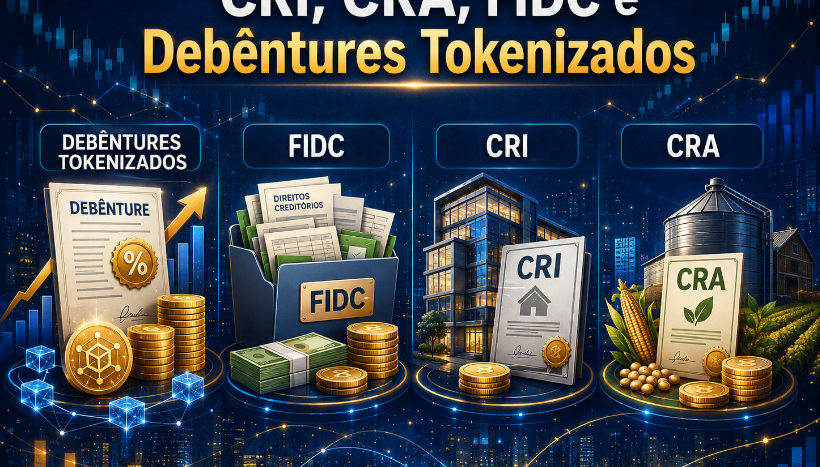

By 2026, the question that asset developers and securitization companies no longer ask is “can this be tokenized?”.
The real question, and one that remains unanswered by many, is: how do tokenized CRIs, CRAs, FIDCs, and debentures truly function within a regulated environment? Not as an experiment, not as a proof of concept. As an operation.
This is precisely where the difference between solid infrastructure and regulatory improvisation becomes critical.
BLOCKBR’s asset tokenization infrastructure for the regulated financial market was built to answer this question with structure, not rhetoric.

What changes when tokenized CRIs, CRAs, FIDCs, and debentures move from paper to reality?
Tokenization does not invent a new legal instrument. It digitally represents an asset that already exists within the regulatory framework of the CVM (Brazilian Securities and Exchange Commission), the BACEN (Central Bank of Brazil), or applicable legislation.
The CRI remains a CRI. The debenture remains a debenture. What changes is the operational flow around that asset.
When a securitization company issues a tokenized CRI, it gains the ability to fractionalize it and distribute it to multiple investors with settlement via smart contract, reducing intermediaries, accelerating cycles, and increasing traceability.
In practice: an issuance that in the traditional model would take 10 to 15 business days, with the registrar, notary office, B3, and back-office operating on separate systems, now takes 2 to 4 business days, with digital registration and an auditable trail from origination.
What previously took days through manual processes can now be accomplished with on-chain registration and linked off-chain documentation, keeping the legal basis intact.
The same principle applies to other structured credit instruments: the CRA (Agribusiness Receivables Certificate) gains wider distribution without losing its link to agribusiness; the tokenized Commercial Note allows for more agile direct fundraising; the CCB (Credit Certificate) structured on blockchain maintains the legal obligation but delivers traceability that the traditional model cannot achieve.
In tokenized FIDC, shares become much more efficiently negotiable, while mandatorily respecting CVM Resolution 175, which regulates these structures. SCP (Special Purpose Company) and SPE (Special Purpose Entity) also enter this flow as origination vehicles, maintaining their legal nature and gaining a digital operational layer.
To make the difference between the instruments concrete:
| Instrument | What remains the same | What changes with tokenization |
| Tokenized CRI | Legal nature, fiduciary regime, securitization company as issuer | Fractional distribution, settlement via smart contract, on-chain traceability |
| Tokenized CRA | Linked to agribusiness, regulatory framework | Extensive distribution network, reduced intermediaries |
| Tokenized FIDC | CVM Resolution 175, senior/subordinated quota structure | More efficient quota negotiability, digital onboarding of quota holders |
| Tokenized debenture | Legal obligation of the issuer, role of the trustee | Smaller, economically viable issuances, automated settlement |
| Tokenized Commercial Note | Short-term nature, issuer obligation | Fast issuance and direct collection speed |
The key point is this: tokenization takes place within the legal framework, never as a substitute for it.

CRI, CRA, FIDC and tokenized debentures: who participates and how the operation is structured.
Structuring tokenized CRI, CRA, FIDC, and debentures requires a workflow with clearly defined participants. Understanding who does what is what distinguishes a legitimate operation from a legal risk.
The originator or structurer, which can be a securitization company, a special purpose entity (SPE), or an issuing company, is the one that conceives and structures the asset. They define the conditions, the underlying asset, and the financial structure.
From there, the issuance and registration platform comes into play, where the token is created with validated legal backing.
It is at this level that BLOCKBR acts as an asset tokenization infrastructure for the regulated financial market, integrating registration, custody, and compliance into a single technical environment.
BLOCKBR Station functions as an institutional orchestration hub in this process, connecting regulated agents, securities brokers, custodians, legal and registration bodies to the tokenization flow. It is not an off-the-shelf product. It is the layer that ensures that each regulatory component is connected before any asset is issued.
Next, the distributor, whether a digital brokerage, an Autonomous Investment Structurer or a whitelabel platform, takes the asset to the market. And the investor accesses the tokenized instrument with on-chain traceability and legally binding documentation.
This process is not optional at any stage. Each point of failure is a real regulatory risk. Anyone trying to cut corners by skipping registration, custody, or compliance is not tokenizing: they are creating liability.

A concrete example of the risk: a platform that issues tokens representing FIDC quotas without qualified custody and without registration with a depository recognized by the CVM (Brazilian Securities and Exchange Commission) may have its entire operation retroactively challenged, exposing issuers and investors to litigation and the impossibility of secondary trading of the positions.
The bottleneck today for tokenized CRIs, CRAs, FIDCs, and debentures is not technological. It’s structural. Securitization companies and structurers attempting to operate asset tokenization without the right foundation continue to encounter friction at every stage, because integrating legal, technology, and compliance into a single workflow is not trivial.
BLOCKBR exists as an asset tokenization infrastructure for the regulated financial market precisely to enable this complete flow, from structuring to distribution, without improvisation.
If your infrastructure still operates with these separate layers, learn about BLOCKBR’s infrastructure and understand how this changes in practice.